As ∥x∥x=1, ∥y∥y=1 and ∥x∥+∥y∥∥x∥+∥x∥+∥y∥∥y∥=1, the second inequality follows exactly from condition 5.
4→5: Let x,y∈Rn,∥x∥≤1,∥y∥≤1 and a,b≥0, a+b=1. Then
∥ax+by∥≤∥ax∥+∥by∥=a∥x∥+b∥y∥=1
□
Induced Norm
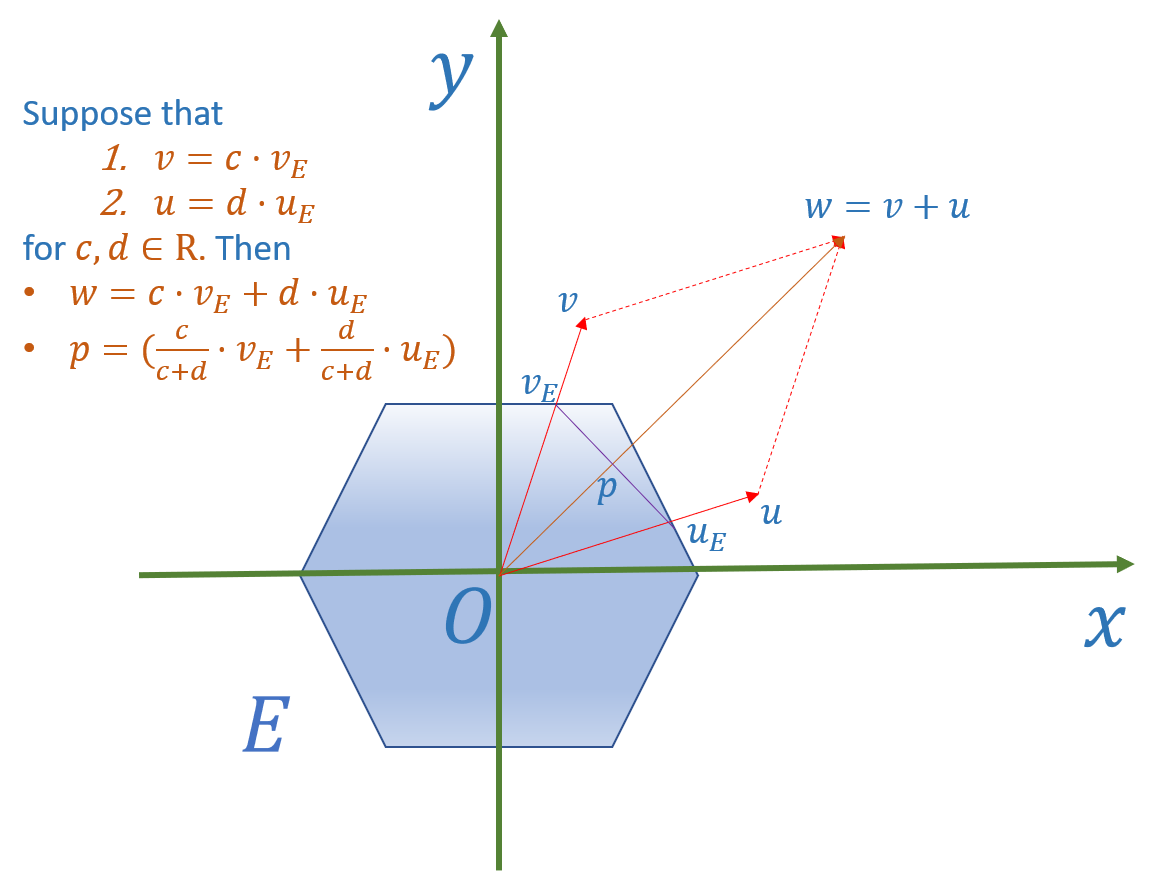
To illustrate a deeper connection between property 4 and 5, we first show how a norm can be induced by a convex and symmetric region centered at the origin O. Let the boundary of the region as E. We are going to induce a norm by E, denoted as ∥⋅∥E.
First, we define
∥x∥E=1,∀x∈E.
For any other vector x∈/E, consider the ray initiated from the origin and with the same direction as x. Denote its intersection point with E as xE. Suppose that x=a⋅xE for some a∈R+. Then we define
∥x∥E=a∥xE∥E=a.
Indeed, if we write the ∥⋅∥2 as the ℓ2 norm, then the value of a is given by ∥xE∥2∥x∥2. Clearly, by definition, ∥⋅∥2 is positive definite and non-negative. To prove that it is absolutely homogeneous, ∀k∈R,
∥kx∥=∥kaxE∥E.
If k≥0, we have ∥kaxE∥E=ka∥xE∥E=ka. Otherwise, if k<0,
∥kx∥=∥kaxE∥E=∥−ka(−xE)∥E=−ka∥(−xE)∥E.
By symmetry of E (with respect to the origin O), ∥(−xE)∥E=∥xE∥E=1. Therefore,
∥kx∥=∣k∣a.
Finally, we have a graphical verification of triangle inequality. Let v,u∈Rn, which intersect with E at vE and uE respectively. If ∥v∥E<1 (∥u∥E<1), then we can extend it along its direction to get its intersection with E. Let c=∥v∥E and d=∥u∥E, then
v=c⋅vE,
u=d⋅uE.
Let w=v+u=c⋅vE+d⋅uE. Let p be the intersection between w and the line segment between v and u. It is easy to verify that
p=c+dcvE+c+dduE
By convexity of the region bounded by E,
∥p∥E≤1
It concludes that ∥w∥E=∥cvE+duE∥E≤c+d=∥v∥E+∥u∥E.
Application
The idea discussed above significantly simplifies the proof of Minkowski inequality.
The p-norm (p≥1) on Rn is given as
∥x∥p=i∈[n]∑∣xi∣pp1
Clearly, p-norm is positive definite, nonnegative, absolutely homogeneous. It is left to verify triangle inequality, which is known as Minkowski inequality for the case of p-norm. This is equivalent to show that
{x∈Rn:∥x∥p≤1}
is convex. The trick here is that ∥x∥p≤1 is equivalent to (∥x∥p)p≤1. Hence,
{x∈Rn:∥x∥p≤1}=⎩⎨⎧x∈Rn:i∈[n]∑∣xi∣p≤1⎭⎬⎫.
The convexity of this set follows directly from the point-wise convexity of the function f(t)=tp.
□
Remark: To appreciate how concise the above proof is, we also give one traditional proof here, which consists of three steps.
Young's Inequality
Theorem. For a,b>0, p,q>0, s.t., p1+q1=1, it holds that
ab≤pap+qbq
Proof. Via the concavity of y=lnx,x>0, we see
lna+lnb=p1lnap+q1lnbq≤ln(pap+qbq).
□
Holder's Inequality
Theorem. For x,y∈Rn, p,q>0, s.t., p1+q1=1, it holds that
i∈[n]∑∣xi∣∣yi∣≤∥x∥p∥y∥q
Proof. The inequality is trivial if x=0 or y=0. Otherwise, let u=x/∥x∥p and v=y/∥y∥q.
It is easy to see that ∥u∥p=∥v∥q=1, and it remains to prove