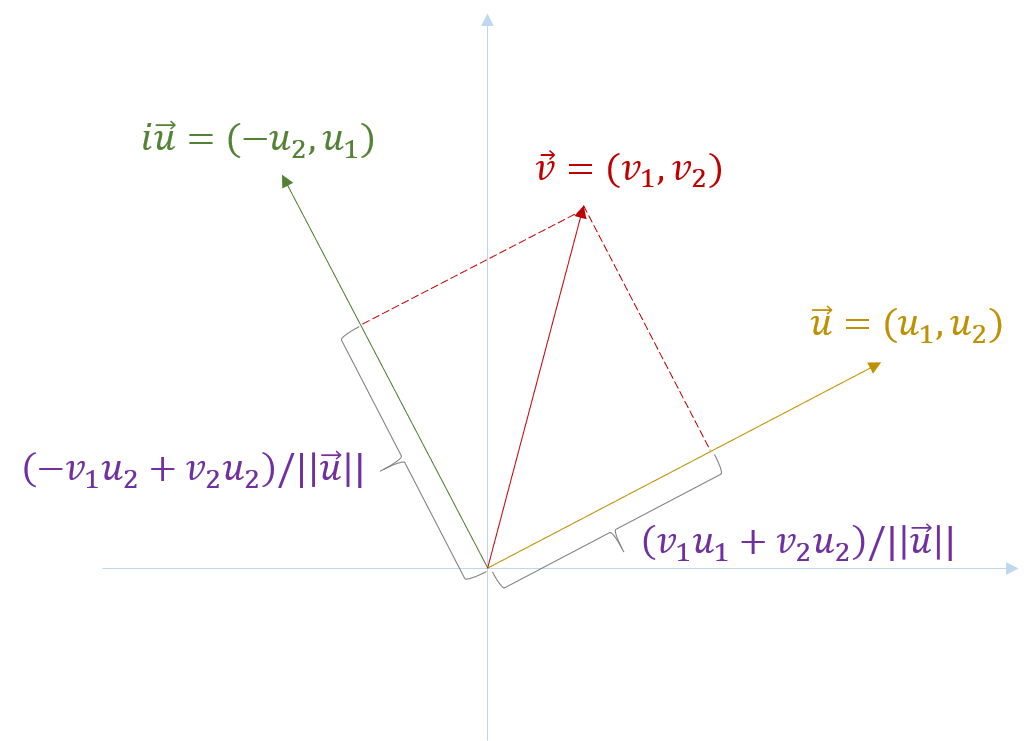
It is tempting to think the inner product should be uTv, as the one for real vectors. Why do we take the conjugate of u? To answer this, we need to study the geometric meaning of inner product. We begin from the inner product in Rn.
Inner Product in Rn
The inner product is closely related to the concept of "length". Generally, we express the length of a vector in term of inner product. Here we take a reverse approach. We consider the length of a vector as a more fundamental concept. Once the length of a vector is defined, it leads naturally the definition of inner product.
For a vector u∈Rn, we define its length as
∣∣u∣∣=i∈[n]∑ui2.
Given two vector u,v∈Rn, the definition of the inner product of uTv stems from the following problem:
Find a vector in the subspace generated by u, such that it distance to v is minimized.
The subspace generated by u is the line that passes through u and can be represented as
{tu:t∈R}.
The problem gives rise to the optimization problem:
t∈Rmin∣∣v−tu∣∣2.
Define
y≐∣∣v−tu∣∣2=∣∣u∣∣2t2−2(vTu)t+∣∣v∣∣2.
By differentiating and setting the derivative equal to zero, we get
y′=2∣∣u∣∣2t−2(vTu)=0⟹t=∣∣u∣∣2vTu.
The inner product appears exactly in the numerator. Its meaning is clear now: it is related to the magnitude of the closest vector in the subspace spanned by u. In case that u is a unit vector, t=vTu is exactly the length of this closest vector.
This also sheds light on the meaning of orthogonality:
If u is orthogonal to v, then the best approximation (measured by ∣∣⋅∣∣) of v in the subspace spanned by u is the zero vector.
Inner Product in Cn
To get the desired expression of inner product Cn, we first extend the definition of length in Rn to Cn. For u∈Cn, define
∣∣u∣∣=i∈[n]∑∣ui∣2.
Given u,v∈Cn, we consider the similar problem:
Find a vector in the subspace generated by u, such that it distance to v is minimized.
However, this time the subspace generated by u is given by
{(tr+iti)u:tr,ti∈R}.
Let ur∈Rn be the real part of u and ui∈Rn be its imaginary part. Then u=ur+iui. Similarly, we can decompose v into v=vr+ivi.