Diffie-Hellman Key Exchange (DHKE) Protocol
Problem. Suppose Alice and Bob are communicating over a public channel and wish to securely exchange a secret number, called the symmetric key, such that only they can know it.
Protocol
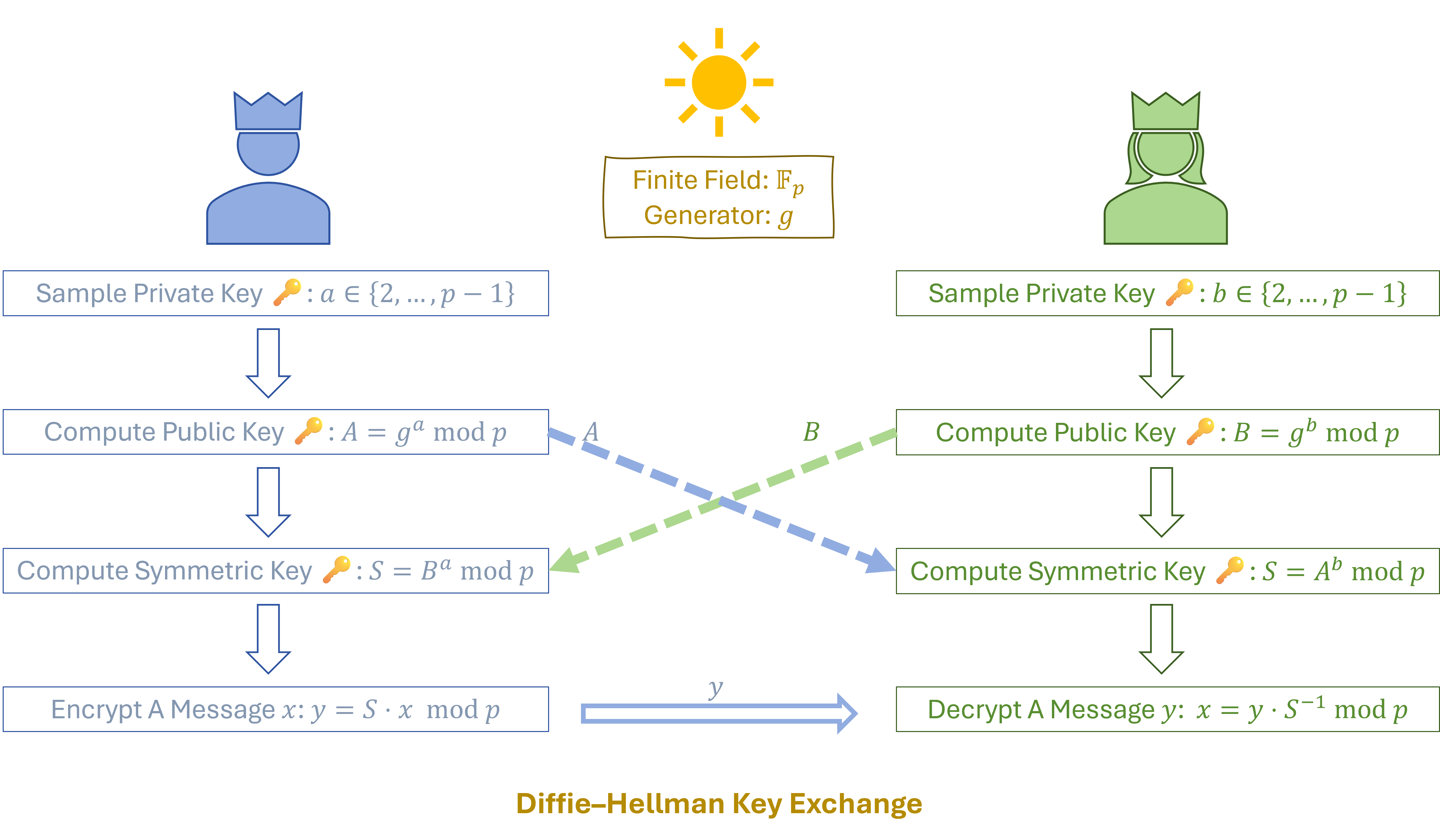
The protocol is illustrated in the figure below. We assume that is a publicly known prime, is the finite field of order , and is a generator of the multiplicative group . The final encryption step may use another algorithm such as AES, with (or some bits of ) serving as the key.
Correctness
The correctness of the protocol follows directly from the commutativity of the multiplicative group :
Security Guarantee
The security of the protocol relies on the computational hardness of the following problem:
Diffie-Hellman Problem (DHP). Given observed by a passive adversary, the problem asks whether the adversary can compute .
It is clear that DHP can be solved if the following problem is solvable:
Discrete Logarithm Problem (DLP) in . Given the finite cyclic group of order , a generator , and an element , the problem asks for such that
However, it is not known whether solving DLP is the only way to solve DHP.
Computation
- and can be efficiently computed using fast exponentiation.
- can be computed as follows:
- By Fermat's Little Theorem: .
- Hence, , which can also be computed via fast exponentiation.
Generalization
The protocol can be generalized to other cyclic groups beyond , such as elliptic curve groups. In that case, the security relies on the hardness of the following problem:
Generalized Diffie-Hellman Problem (DHP). Given a finite cyclic group of order , a generator , and two elements , , the problem is to compute .
This problem can be solved if the following is easy:
Generalized Discrete Logarithm Problem (DLP). Given a finite cyclic group with operation and order , a generator , and an element , the problem asks for such that
It is worth noting that the discrete logarithm problem is not hard in all cyclic groups; hardness depends on the choice of group.
ElGamal Encryption
Problem. Suppose Alice and Bob are communicating over a public channel. Alice wants to publish a public key so that Bob can encrypt a message for her, while only Alice can decrypt it using her secret key.
Protocol
The protocol is illustrated in the figure below.
It can be seen as a reordering of the steps in the Diffie-Hellman key exchange protocol.
Its correctness and security guarantees follow directly from the DHKE framework.
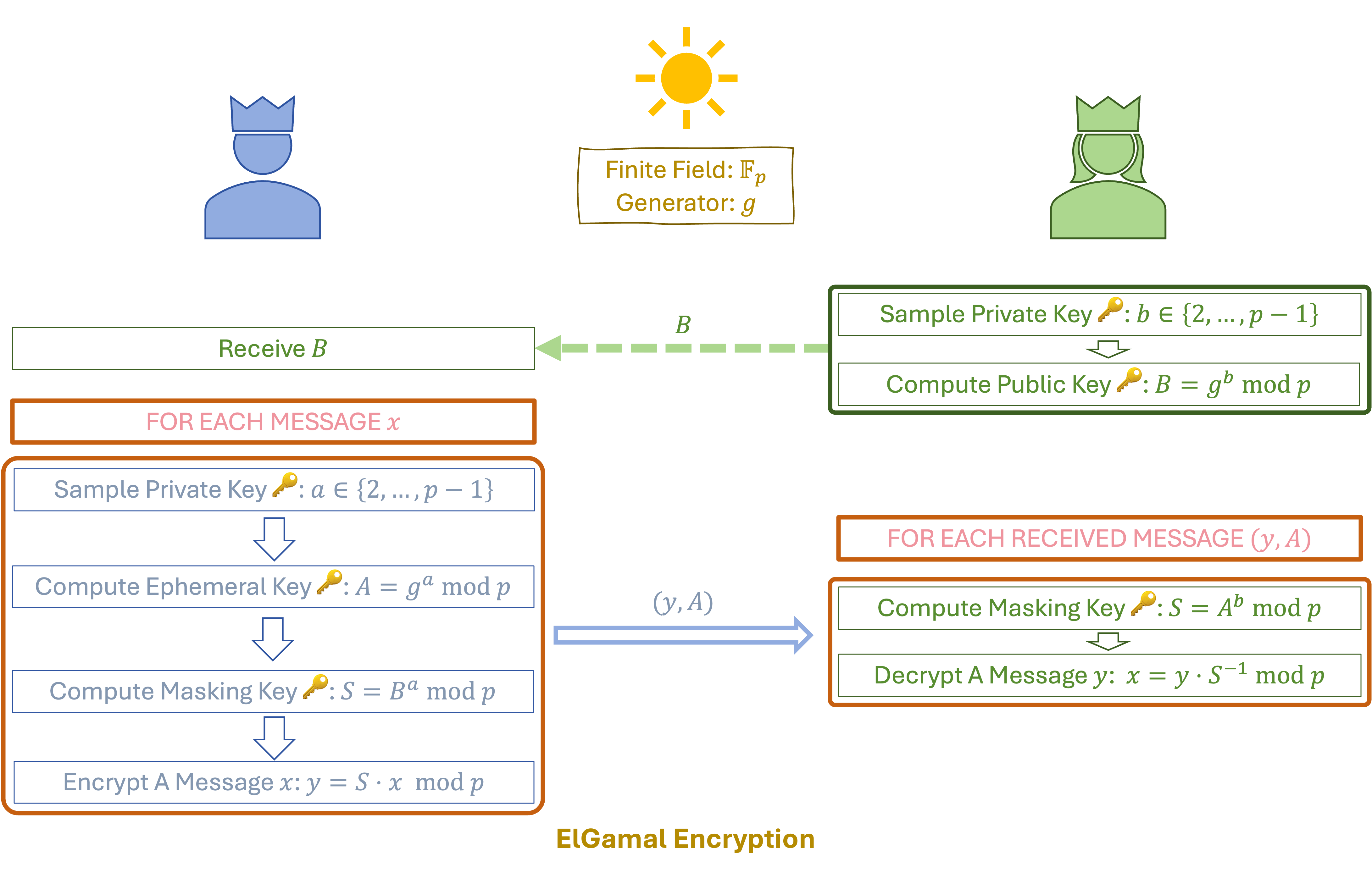
Additional Remark. Each time Bob encrypts a message, a fresh masking key is generated. Thus, even if the same message is sent multiple times, the ciphertexts will differ. This property is known as probabilistic encryption.
Reference
[1] C. Paar, J. Pelzl, and T. Güneysu, "Understanding Cryptography: From Established Symmetric and Asymmetric Ciphers to Post-Quantum Algorithms." Berlin, Heidelberg: Springer Berlin Heidelberg, 2024. doi: 10.1007/978-3-662-69007-9.